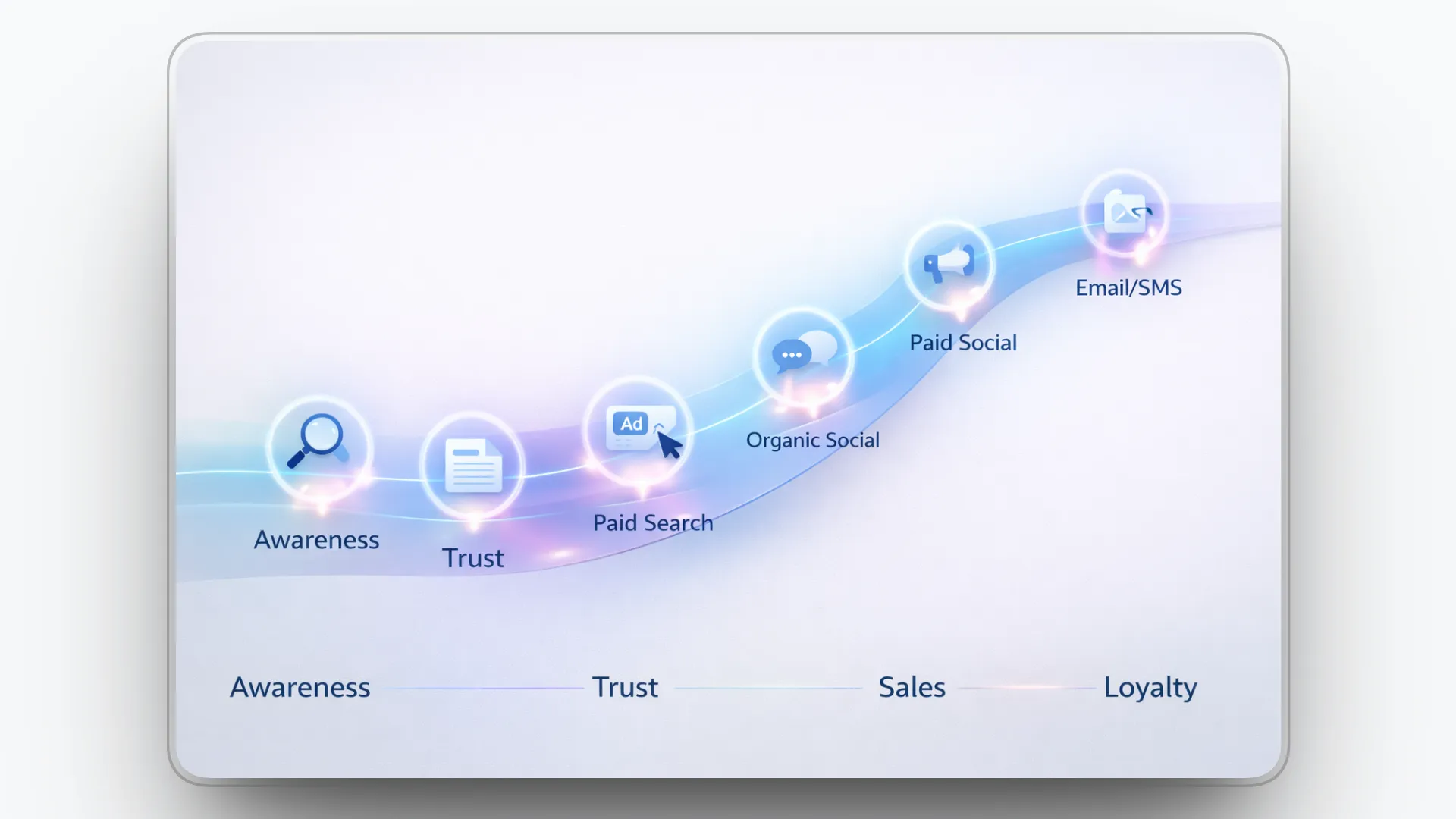
A full funnel digital marketing strategy is a plan that moves people through the top, middle, and bottom of the funnel. It uses the right mix of channels so awareness, trust, and sales support each other. In Q3 2025, US retail ecommerce sales were $310.3 billion and it made up 16.4% of total retail sales.
Most teams feel stuck because every channel looks important. You may get traffic but not enough leads. Or you get leads that do not convert. Costs rise, results feel unclear, and reporting is hard to trust. This is common in Dallas where competition is high in search and paid ads.
In this guide, we will cover 7 types of digital marketing under one framework. You will learn where each fits in the funnel and what to measure as you improve.
What is a full funnel strategy?
A full funnel strategy means you market to people at every step of the buying journey. Instead of only trying to close sales, you also focus on being discovered, earning trust, and staying top of mind. This makes your results more stable because each channel supports the next step.
- Top of the funnel means get found
- Middle of the funnel means build trust
- Bottom of the funnel means get sales
After the funnel is what happens after the first purchase. It is how you keep customers and grow referrals.
Funnel Stages Quick Cheat Sheet
Use this cheat sheet to match the right channel to the right stage.
- TOFU means awareness
- MOFU means consideration
- BOFU means conversion
- Loyalty means repeat and referrals
7 Digital Marketing Types and Where Each Fits in the Funnel
Digital marketing is how you get customers using online channels like search, ads, social media, email, and your website. A full funnel approach uses different channels for different stages so you get found, build trust, and drive sales.
- SEO
- Content marketing
- Paid search ads
- Paid social ads
- Organic social media
- Email and SMS marketing
- CRO and landing pages
1. SEO (Search Engine Optimization)
SEO works when your site answers real buyer searches and makes it easy to take action. It is not just blogs. It is service pages, proof, and clear structure. It compounds over time and lowers your cost per lead when it is done right.
Best Funnel Stage
Top and middle
What to Do
Start with one main service page that matches a buying search. Example Dallas digital marketing agency or Dallas PPC agency. Add supporting pages for each service you sell. Then write blogs that answer the questions buyers ask before they hire. Link each blog to the service page it supports. Improve internal links so your main service pages get the most links. Add proof on key pages like reviews, results, and a simple process.
What to Measure
Organic leads and booked calls. Clicks and impressions by topic. Conversion rate from organic traffic. Top organic landing pages.
2. Content Marketing (Blogs, Guides, Case Studies)
Content builds trust before someone is ready to buy. It makes your brand feel obvious and safe. It also supports sales because prospects read before they reply or book. Good content removes confusion and shortens the decision cycle.
Best Funnel Stage
Top and middle
What to Do
Open with a short answer that defines the topic in simple words. Add a step by step section that shows how to do it. Include a short checklist readers can copy. Add common mistakes and simple fixes. Include one short section that helps buyers decide what to choose and why. Add a small FAQ to cover long tail searches. End with a clear next step that matches the funnel stage.
What to Measure
Leads from content pages. Assisted conversions where content was read before a lead. Internal link clicks to service pages. Top queries and intent match.
3. Paid Search Ads (Google Ads)
Paid search is for high intent people who need help now. It gives you speed and control because you can turn demand into leads quickly. It also shows you which messages and offers people respond to. That insight can improve your SEO pages and sales calls too.
Best Funnel Stage
Bottom
What to Do
Pick high intent keywords that show someone wants help now. Keep campaigns separated by service so your ads stay specific. Match the ad message to the landing page headline. Use one clear offer and one main call to action. Track calls and form leads. Add negative keywords weekly to stop wasted spend. Send traffic to a focused landing page, not the home page.
What to Measure
Cost per lead and cost per booked call. Landing page conversion rate. Lead quality by campaign and keyword group. Return on ad spend when revenue tracking is available.
4. Paid Social Ads (Meta, LinkedIn, TikTok)
Paid social is how you create demand, not just capture it. It puts your offer in front of the right people before they start searching. It is also how you stay in front of warm prospects until they are ready. Strong creativity and proof usually matter more than perfect targeting.
Best Funnel Stage
Top and bottom
What to Do
Start with simple creatives that call out the audience and problem. Test multiple hooks and angles, not just one ad. Build a proof focused retargeting campaign for visitors and engagers. Show results, reviews, and short case stories in retargeting. Keep the next step easy like book a call or request a quote. If you are B2B, test LinkedIn with job roles and industries.
What to Measure
Reach and click through rate for awareness. Cost per lead for retargeting. Lead quality by audience type. Frequency to avoid ad fatigue.
5. Organic Social Media
Organic social is your credibility layer. It helps people feel like they know you. It also answers the quiet questions buyers have before they reach out. Consistency wins here because it keeps you top of mind.
Best Funnel Stage
Top and middle
What to Do
Choose one or two platforms and post consistently. Share short tips and quick answers that match your services. Use proof posts often like reviews, wins, and before and after results. Show your process so people understand what working with you looks like. Turn common sales questions into posts. Always give one simple next step like visit a page, message us, or book a call.
What to Measure
Saves, shares, comments, and messages. Profile visits and link clicks. Traffic to service pages. Leads that mention social.
6. Email and SMS Marketing
Email and SMS turn interest into action through follow up and reminders. They help you stay in control of communication instead of relying on algorithms. They also bring people back when timing was the only issue. This channel is where relationships turn into repeat business.
Best Funnel Stage
Middle, bottom, and loyalty
What to Do
Set up a welcome series that explains what you do and who you help. Build a short nurture sequence that answers top questions and adds proof. Follow up fast after form fills and calls. Segment by interest so messages stay relevant. Keep each message focused on one point and one call to action. Use SMS for reminders and high intent follow ups, not daily promotions.
What to Measure
Clicks and replies. Booked calls from email and SMS. Unsubscribe rate. Revenue or pipeline influence if tracked.
7. CRO and Landing Pages (Conversion Rate Optimization)
CRO is how you make every channel perform better without spending more. It removes friction and makes the next step feel easy. Small changes can lift leads fast because they affect all traffic sources. It is the bridge between clicks and real revenue.
Best Funnel Stage
Bottom
What to Do
Make the headline clear and specific above the fold. State the offer and what happens next. Reduce form friction by asking only what you need. Add proof near the top like reviews, logos, and results. Keep one main call to action. Make the page fast on mobile. Test one change at a time like headline, form, or call to action.
What to Measure
Landing page conversion rate. Cost per lead changes over time. Booked call rate. Form drop offs.
How to Build a Simple Full Funnel Strategy That Turns Attention into Sales
A full funnel plan connects your marketing from first touch to final conversion. It helps you stop guessing and build a clear path that brings more qualified leads and more consistent results.
- Pick one audience and one offer: Choose one clear customer type and one main service. Write the offer in one sentence so it is easy to sell and easy to measure.
- Set tracking before you launch: Track form leads, phone calls, and key clicks. Use UTMs so you know which channel and campaign brought each lead.
- Build TOFU to get found: Use SEO, content, and social media to reach new people. Focus on topics and pages that match what they search and ask.
- Build MOFU to build trust: Create one lead magnet that solves a real problem. Set up a short email nurture series that answers questions and shows proof.
- Build BOFU to drive sales: Run paid search for high intent keywords. Retarget visitors who did not convert and improve landing pages so more clicks become leads.
What to measure at each stage (simple KPIs)
TOFU (Get Found)
- Impressions and reach
- Click through rate to your site
- Website sessions from organic and social
- Percent of new visitors
- Engaged time on page or scroll depth
MOFU (Build Trust)
- Lead conversion rate from traffic
- Leads and cost per lead
- Lead magnet opt in rate
- Email click rate and replies
- Retargeting click rate and cost per lead
BOFU (Drive Sales)
- Booked calls or purchases
- Cost per booked call or cost per sale
- Show up rate for booked calls
- Close rate from leads to customers
- ROAS if you track revenue
Common Full Funnel Mistakes and Quick Fixes
Most marketing funnels fail because one stage is missing, weak, or disconnected from the next. Use the quick fixes below to improve lead quality, conversions, and booked calls without rebuilding everything from scratch.
1) BOFU Only
Mistake: You run “book a call” and “get a quote” ads to cold audiences who do not know your agency yet. Costs rise and lead quality drops.
Quick fix: Add a simple awareness layer first.
- Run 1 to 2 awareness creatives that teach one problem and one outcome
- Send cold traffic to a helpful guide or checklist before a sales page
- Retarget video viewers and site visitors with your MOFU and BOFU offers
2) Weak Landing Page
Mistake: The ad promise is strong, but the page does not clearly explain the offer, proof, and next step.
Quick fix: Fix the page flow so people can decide fast.
- Above the fold: clear offer and one primary CTA
- Proof: testimonials, logos, case results, screenshots
- What you do: 3 bullets plus one short example
- Next steps: what happens after the form or call
- FAQ: objections answered in plain language
3) No Nurture
Mistake: Leads click once and then go cold because there is no follow up system to build trust.
Quick fix: Add a short nurture path for 7 to 10 days.
- Send a simple sequence: value, proof, objections, CTA
- Share one case study and one process overview
- Match nurture with retargeting ads using the same message order
4) Wrong Keywords
Mistake: You target broad terms that bring traffic but not decision makers.
Quick fix: Shift toward high intent searches.
- Prioritize pricing, comparison, alternative, and industry terms
- Build pages that match intent such as pricing, industries, and comparisons
- Use negative keywords to filter job seekers and students
5) No Next Step
Mistake: Content gets views, but readers do not know what to do next, so it does not produce leads.
Quick fix: Add clear routing on every TOFU and MOFU page.
- Add 2 to 4 internal links to services, case studies, pricing, and contact
- Add a contextual CTA inside the content, not only at the end
- Add a related content section that points to service pages and proof
6) Tracking Clicks
Mistake: You optimize for CTR and traffic instead of pipeline results.
Quick fix: Track outcomes that match revenue.
- Track calls, forms, booked calls, qualified leads, and closed deals
- Use call tracking and CRM attribution
- Review weekly: spend, leads, qualified, booked, revenue
7) No Retargeting
Mistake: High intent visitors leave and you never give them a second chance.
Quick fix: Retarget by intent and time window.
- Days 1 to 7: proof and strong CTA
- Days 8 to 14: objections like price, timeline, trust
- Days 15 to 30: offer or reminder
- Segment pricing visitors separately from blog readers
8) Slow Response
Mistake: Leads submit a form and wait too long, then book another agency first.
Quick fix: Improve speed to lead.
- Send an instant confirmation with a calendar link
- Call within 5 to 15 minutes during business hours
- Add a short form with best time to call
9) Offer Mismatch
Mistake: You ask cold visitors to book a call without giving enough trust or value first.
Quick fix: Match the offer to the funnel stage.
- TOFU: guide, checklist, benchmark
- MOFU: audit, teardown, roadmap
- BOFU: strategy call, pilot, proposal
Full Funnel Reporting That You Can Actually Trust
Most reporting breaks because it stops at clicks. At Nativz, we track the full path from first visit to booked call and closed deal, so you know what is driving real growth and what is just noise.
We keep it simple with a few numbers for each stage. Top of funnel is qualified visits, middle is form fills and sales ready leads, bottom is booked calls, show up rate, and close rate. We use UTMs, call tracking, and your CRM so every lead has a clear source and status, then we pull it into one dashboard you can trust.
FAQs
What is a full funnel strategy?
A full funnel strategy markets to people from first touch to purchase and beyond. It uses different channels at each stage so you build awareness, trust, and sales in a connected way.
What are the best channels for TOFU?
TOFU works best with SEO, content, and social media because they help new people discover you. The goal is reach, clicks, and engaged visits, not instant sales.
What is MOFU marketing?
MOFU is the stage where people compare options and decide who to trust. Lead magnets, email nurture, retargeting, and case studies help move them closer to action.
What is BOFU marketing?
BOFU focuses on conversions like booked calls, purchases, or quotes. Paid search, retargeting, and strong landing pages usually drive the best results here.
How do I know which stage is not working?
If traffic is low, your TOFU is weak. If you have traffic but few leads, your MOFU and landing pages need work. If you get leads but no sales, your BOFU offer, follow up, or lead quality is the issue.
How long does a full funnel strategy take to work?
Paid ads can produce leads quickly if tracking and landing pages are ready. SEO and content usually take longer, but they build a more stable pipeline over time.